
Direct-to-Chip Cooling Technology: How It Works
Quick Summary
- Mechanism: Cold plates on GPU/CPU with microchannel coolant flow
- Heat Removal: 80-90% of GPU heat captured at source
- GPU Support: Enables TDP up to 2000W+ per GPU
- Energy Savings: 40-50% reduction in facility cooling energy
- Retrofit: Can be deployed in existing air-cooled data centers with CDU installation
Direct-to-chip (DTC) liquid cooling represents the most advanced thermal management technology available for high-density GPU computing. By delivering coolant directly to cold plates mounted on GPU and CPU packages, DTC cooling removes heat at its source with extraordinary efficiency, enabling the 700W+ GPU power envelopes required for modern AI training while reducing facility energy consumption by 30-50%. This guide provides an in-depth technical examination of DTC cooling technology, implementation considerations, and operational best practices.
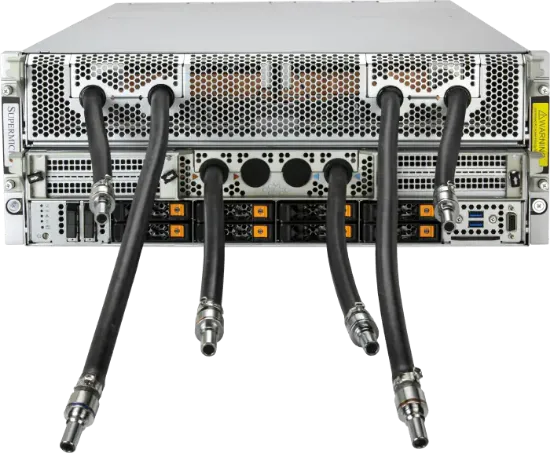
How Direct-to-Chip Cooling Liquid-cooled GPU server Works
DTC cooling begins with the cold plate—a precision-machined metal block (typically copper or nickel-plated copper) that mounts directly on the GPU package using thermal interface material (TIM). The cold plate contains microchannel fins (0.2-0.5mm width) that create high surface area for heat transfer. Coolant flows through these microchannels at 1-5 liters per minute, absorbing heat through forced convection.
Coolant flow path: Coolant (25-45°C) enters the cold plate through precision-machined inlet ports, flows through microchannel arrays directly above GPU hotspots, exits at 30-55°C (depending on flow rate and GPU power), and returns to the Coolant Distribution Unit (CDU) for heat rejection to facility water or ambient air.
Thermal performance: DTC cold plates achieve thermal resistance of 0.01-0.03 °C/W, compared to 0.1-0.3 °C/W for high-performance air coolers. For a 700W H100 GPU, DTC maintains junction temperatures at 65-75°C with 35°C coolant inlet, while air cooling would reach 85-95°C under identical conditions. This 15-25°C temperature reduction directly improves GPU performance by reducing thermal throttling and enabling higher boost clock frequencies.
DTC Cooling System Components
A complete DTC cooling system comprises several integrated subsystems:
Cold Plates: Custom-machined for each GPU and CPU package geometry. NTS DTC cold plates for H100/H200 GPU packages feature optimized microchannel patterns targeting GPU hotspot locations (tensor core clusters, HBM stacks). Each cold plate includes quick-disconnect fittings for serviceability.
Coolant Distribution Unit (CDU): The CDU manages coolant temperature, flow rate, pressure, and quality. Key specifications: 30-200kW thermal capacity per CDU, ±0.5°C coolant temperature control, 20-200 LPM flow rate, 50-200 kPa pressure differential, dual redundant pumps (N+1), and integrated leak detection. Each CDU supports 2-8 GPU servers depending on thermal load.
Manifold and Tubing: Rack-level coolant distribution uses stainless steel or reinforced polymer manifolds with 3/8" to 1/2" outer diameter tubing. Quick-disconnect fittings at each server connection enable hot-swap server replacement without coolant loop shutdown. Manifolds include isolation valves for individual server maintenance.
Facility Water Loop: The CDU rejects heat to facility water through plate heat exchangers or dry coolers. Facility water typically enters at 15-25°C (depending on geographic location and cooling tower efficiency) and returns at 25-40°C. For maximum efficiency, DTC systems can reject heat directly to outdoor dry coolers without chiller intervention.
DTC Cooling for AI Workloads: Performance Benefits
DTC cooling provides three primary benefits for AI infrastructure:
1. Higher GPU Performance: Lower operating temperatures enable NVIDIA GPU Boost to maintain higher clock frequencies. DTC-cooled H100 GPUs sustain 1.9-2.0 GHz boost clock under full load, compared to 1.7-1.8 GHz with air cooling—a 5-10% performance improvement. Over sustained training runs of days to weeks, this translates to 3-7% faster time-to-solution.
2. Reduced Facility Energy: DTC cooling eliminates the need for computer room air conditioners (CRACs) or computer room air handlers (CRAHs) for GPU heat removal. Facility cooling energy drops from 30-40% of IT load (air cooled) to 10-15% of IT load (DTC cooled). For a 1MW AI cluster, this saves $200,000-$400,000 annually in power costs.
3. Increased Rack Density: DTC cooling supports 40-80kW per rack versus 15-25kW for air cooling, reducing data center floor space requirements by 50-70%. For organizations with space-constrained data centers, DTC enables 2-4x more AI compute capacity within existing facilities.
Implementation Considerations for Government Deployments
Federal AI data centers implementing DTC cooling must address additional reliability and security requirements. N+1 CDU redundancy with automatic failover is standard for government deployments. Leak detection at every connection point (cold plate, manifold, server) must feed into facility monitoring systems with automated shutdown capability.
Coolant selection requires special attention for government facilities. Dielectric fluids (e.g., 3M Novec or engineered hydrocarbon fluids) eliminate electrical conductivity risks but have higher environmental impact (global warming potential). Water-based coolants with corrosion inhibitors are preferred for sustainability but require leak detection and secondary containment.
Related Content
Explore more about this topic:
- Liquid Cooling vs Air Cooling for AI Racks
- Coolant Distribution Unit Selection
- Data Center Tier Classification for AI
How reliable is DTC liquid cooling?
Industrial DTC cooling systems achieve 99.99%+ availability with proper maintenance. Key reliability factors: redundant pumps, particle filtration (50-micron or better), corrosion inhibitor monitoring, and regular coolant analysis (quarterly). Mean time between failures (MTBF) for CDU pumps exceeds 50,000 hours.
Can DTC cooling be added to existing GPU servers?
Retrofit is possible for servers with compatible chassis designs. NTS offers DTC conversion kits for Supermicro, Dell, and HPE GPU servers. Retrofit cost: $3,000-$6,000 per server including cold plates, tubing, and CDU connection. Installation requires 2-4 hours per server by qualified technicians.
What maintenance does DTC cooling require?
Quarterly: coolant quality analysis (conductivity, pH, corrosion inhibitor concentration), filter replacement (if equipped), and connection integrity check. Annual: coolant replacement (3-5 year interval for engineered fluids), pump bearing inspection, and cold plate thermal performance verification.