
GPU Cluster Networking Architecture: InfiniBand, Ethernet…
Quick Summary
- InfiniBand NDR400: 400 Gbps, lowest latency, standard for AI training
- NVLink: 900 GB/s GPU-GPU, intra-node only, essential for tensor parallelism
- Ethernet: 400GbE RoCE, improving but higher latency than InfiniBand
- Topology: Fat-tree or dragonfly for optimal all-to-all communication
- Recommendation: NVLink inside node, InfiniBand between nodes
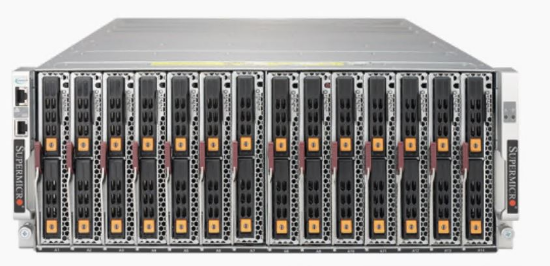
GPU Cluster Network Fabric Options HGX B200 server
Network architecture is the most critical determinant of multi-GPU training performance. The interconnect fabric must support all-to-all communication patterns with minimal latency and maximum bandwidth to enable efficient distributed training. Three primary networking technologies compete for GPU cluster fabrics: InfiniBand, NVIDIA NVLink, and high-speed Ethernet (RoCE). Each offers distinct performance characteristics, cost structures, and ecosystem maturity.
| Technology | Bandwidth | Latency | Topology | Best For |
|---|---|---|---|---|
| NVLink 4.0 | 900 GB/s (intra-node) | <100ns | Full-mesh via NVSwitch | Intra-node GPU communication |
| InfiniBand NDR400 | 400 Gb/s (400 Gbps) | <500ns | Fat-tree, Dragonfly | Multi-node training clusters |
| Ethernet 400GbE RoCE | 400 Gb/s | 1-3us | CLOS, Spine-leaf | General-purpose, storage |
| NVLink Switch | 900 GB/s per GPU | <200ns | 3-level fat-tree | Large NVLink domains (256 GPUs) |
InfiniBand: The AI Training Standard
InfiniBand dominates AI training clusters due to its native Remote Direct Memory Access (RDMA), lossless transport, and ultra-low latency. Mellanox (NVIDIA) InfiniBand NDR400 delivers 400 Gbps per port with sub-microsecond latency, providing the performance required for gradient synchronization in distributed training. InfiniBand's sharp-bang congestion control prevents TCP-like collapse under all-to-all communication patterns common in data-parallel training.
NVLink for Intra-Node Communication
NVLink provides the highest-bandwidth GPU-to-GPU interconnect within a single server node. The fourth-generation NVLink in H100 delivers 900 GB/s bidirectional bandwidth per GPU—7x more than PCIe Gen5. NVLink Switch extends this to 256 GPUs in a single NVLink domain, enabling tensor parallelism across multiple nodes without InfiniBand's protocol overhead.
Ethernet for Cloud-Scale Training
RoCE (RDMA over Converged Ethernet) has improved significantly with NVIDIA Spectrum-4 Ethernet switches delivering 400GbE with RDMA. While Ethernet's latency is 2-3x higher than InfiniBand, its ubiquity and lower cost make it attractive for organizations already standardized on Ethernet infrastructure. New congestion control algorithms (DCQCN, TIMELY) have narrowed the performance gap for AI workloads.
Government Networking Requirements
Federal AI deployments require networking equipment that supports encryption standards mandated by FIPS 140-3 and NSA Suite B. InfiniBand encryption is available through NVIDIA's Innova IPsec adapters, while Ethernet supports MACsec at line rate. For classified environments, optical encryption at the physical layer provides the highest security assurance.
Related Content
Explore more about this topic:
- How Tensor Cores Accelerate Deep Learning
- What is NVLink? GPU Interconnect Guide
- NVIDIA B200 vs H100: Architecture Comparison
Can I use standard Ethernet for AI training?
Yes, but expect 20-40% lower performance compared to InfiniBand for all-to-all communication patterns. Ethernet with RoCEv2 and proper congestion control can achieve adequate performance for data-parallel training but struggles with tensor parallelism.
What network topology is best for AI training?
Fat-tree (leaf-spine) is most common for clusters up to 1,024 GPUs. Dragonfly+ (2-level) scales to 10,000+ GPUs with lower latency variability. The optimal topology depends on cluster size and communication pattern.