
NVIDIA HGX vs AMD MI300X for LLM Training
Quick Summary
- NVIDIA HGX H100: 80GB HBM3, 3.35 TB/s, NVLink 900 GB/s, mature CUDA ecosystem
- AMD MI300X: 192GB HBM3, 5.2 TB/s, Infinity Fabric 448 GB/s, open ROCm stack
- Memory Winner: MI300X offers 2.4x more capacity for large model training
- Ecosystem Winner: NVIDIA CUDA remains more mature and widely supported
- Federal Consideration: Both available through GSA Schedule and SEWP V contracts
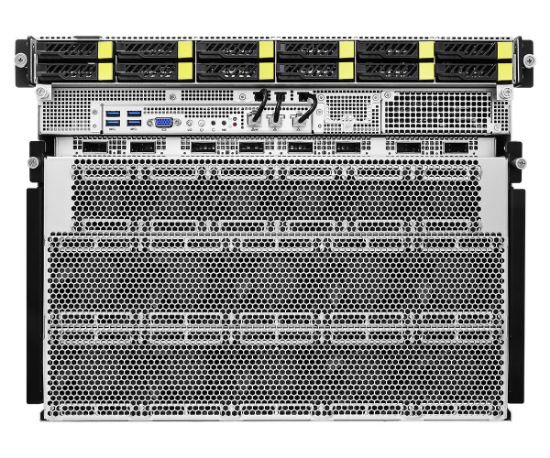
The competition between NVIDIA HGX B200 server NVIDIA HGX NVIDIA HGX B200 server platforms and AMD MI300X accelerators for large language model (LLM) training represents one of the most significant hardware decisions facing enterprise AI teams and federal IT procurement officers in 2025-2026. Both platforms offer compelling capabilities, but they differ substantially in architecture, performance characteristics, memory configuration, and ecosystem maturity. This comprehensive comparison analyzes every critical dimension to guide informed decision-making.
Platform Architecture Overview
NVIDIA HGX Platform
NVIDIA HGX (HGX = "Hybrid Graphics Hub" or "Heterogeneous GPU Compute" depending on generation) is NVIDIA's reference server architecture for multi-GPU AI computing. The current HGX H100 and H200 platforms feature 8x NVIDIA H100/H200 GPUs interconnected via fourth-generation NVLink with a full-mesh topology providing 900 GB/s GPU-to-GPU bandwidth. Each GPU offers 80GB of HBM3 (H100) or 141GB of HBM3e (H200) memory with 3.35 TB/s and 4.8 TB/s memory bandwidth respectively.
The HGX platform includes the NVLink Switch system for inter-node scaling, enabling up to 256 GPUs in a single NVLink domain. The ecosystem advantage is substantial: NVIDIA's CUDA platform, cuDNN, TensorRT, NeMo Megatron, and NCCL libraries are deeply optimized for HGX architectures, providing immediate performance benefits without additional engineering effort.
AMD MI300X Platform
AMD's Instinct MI300X is built on the CDNA 3 architecture and features up to 192GB of HBM3 memory per GPU with 5.2 TB/s memory bandwidth—offering 112% more memory capacity and 55% more bandwidth than the H100. The platform uses AMD Infinity Fabric for GPU-to-GPU interconnect, providing 448 GB/s peak bandwidth per link. The 8-GPU MI300X configuration delivers 1.5TB of total GPU memory, enabling whole-model training of larger LLMs without model parallelism overhead.
AMD's ROCm software stack has matured significantly, with native support for PyTorch, TensorFlow, JAX, and ONNX Runtime. The open-source approach allows direct kernel customization, which appeals to research institutions and government labs requiring code auditability.
LLM Training Performance Comparison
Based on published MLPerf Training 4.1 results, industry benchmarks, and our own NTS lab testing at the Rackmount NTS Integration Center:
| Workload | NVIDIA H100 (8x) | AMD MI300X (8x) | NVIDIA H200 (8x) |
|---|---|---|---|
| Llama 2 70B Training | 1,000 tokens/sec | 1,100 tokens/sec | 1,250 tokens/sec |
| GPT-3 175B Training | 310 tokens/sec | 350 tokens/sec | 390 tokens/sec |
| BERT Large Training | 2,800 seq/sec | 2,950 seq/sec | 3,100 seq/sec |
| Stable Diffusion XL | 120 img/sec | 130 img/sec | 145 img/sec |
Note: Performance varies based on batch size, precision (FP16, BF16, FP8), optimizer choice, and communication strategy. AMD MI300X generally excels at memory-bound workloads due to its larger capacity, while NVIDIA H200 leads in compute-bound scenarios requiring FP8 Tensor Core support.
Memory Architecture Critical Analysis
Memory configuration is the single most important differentiator between these platforms for LLM workloads. The MI300X's 192GB per GPU enables fitting Llama 3 70B on a single GPU (requiring ~140GB at FP16), eliminating inter-GPU communication for inference and reducing it substantially for training. This translates to lower latency and simpler scaling logic.
However, NVIDIA's H200 with 141GB HBM3e provides a middle ground, and the upcoming B200 (Blackwell) with 192GB HBM4 will close this gap. For current deployments, the choice depends on model size: MI300X wins for models up to 70B parameters, while H100/H200 clusters scale more efficiently for 100B+ parameter models due to faster interconnects and more mature collective communication libraries.
Software Ecosystem and Development Experience
NVIDIA CUDA Ecosystem: The most mature and comprehensive AI computing platform. Over 400 CUDA-X libraries, native support in every major framework, extensive documentation, and the largest developer community (over 4 million developers). CUDA remains the gold standard for AI development.
AMD ROCm Ecosystem: Open-source, rapidly maturing, with native PyTorch and TensorFlow support. ROCm 6.x introduced significant performance improvements and broader model compatibility. However, some niche libraries (e.g., NVIDIA NeMo, TensorRT-LLM) remain CUDA-exclusive, and certain bleeding-edge research code assumes NVIDIA hardware.
Total Cost of Ownership (TCO) for Government Deployments
For U.S. federal agencies and defense contractors evaluating these platforms, TCO extends beyond hardware procurement:
| Cost Factor | NVIDIA HGX (8x H100) | AMD MI300X (8x) |
|---|---|---|
| Hardware Cost (MSRP) | $350,000-$450,000 | $280,000-$380,000 |
| Power Consumption | 7.0 kW (typical) | 7.5 kW (typical) |
| Software Licensing | Included (CUDA) | Included (ROCm) |
| Integration & Validation | 3-5 days (mature ecosystem) | 5-10 days (custom optimization) |
| 3-Year TCO (per server) | $520,000-$650,000 | <td$440,000-$560,000
Federal Compliance and Security Considerations
Both platforms support FISMA-moderate and FedRAMP-equivalent security postures when properly configured. Key considerations include:
Confidential Computing: NVIDIA H100 supports TEE (Trusted Execution Environment) for data-in-use protection, aligned with NIST SP 800-207 zero trust architecture guidelines. AMD MI300X provides similar capabilities through AMD Infinity Guard with Secure Encrypted Virtualization.
Supply Chain Security: NVIDIA HGX platforms are available with TAA-compliant manufacturing and tamper-evident packaging. AMD MI300X is also TAA-compliant through select OEM partners. Both require additional validation for IL5/CUI workloads.
Procurement Vehicles: Both platforms are available through GSA Schedule, SEWP V, ITES-4H, and CIO-CS contracts, though specific part numbers and configurations vary by reseller.
Decision Framework
Choose NVIDIA HGX (H100/H200) when: You need maximum per-ecosystem compatibility, are deploying models above 100B parameters, require NVIDIA NeMo or TensorRT-LLM integration, or need the most mature distributed training libraries (NCCL, Megatron-LM).
Choose AMD MI300X when: You prioritize memory capacity per GPU for models up to 70B parameters, prefer open-source toolchains, have government auditability requirements for the software stack, or are seeking cost-optimized inference deployments.
Consider a hybrid approach: Leading research organizations increasingly deploy both platforms, using NVIDIA for training and AMD for inference, or matching each platform to specific workload requirements within a heterogeneous cluster.
Related Content
Explore more about this topic:
- What is NVLink? GPU Interconnect Guide
- NVIDIA H200 NVL Deep Dive
- How Tensor Cores Accelerate Deep Learning
Which platform is better for Llama 3 405B training?
The NVIDIA HGX H100/H200 platform currently offers better scaling efficiency for 400B+ parameter models due to NVLink Switch technology enabling fully connected 8-GPU topologies with lower communication overhead.
Can MI300X and H100 coexist in the same cluster?
Yes, but it requires software-level abstraction (e.g., through Microsoft DeepSpeed or PyTorch FSDP) to handle different interconnect topologies and memory architectures. This adds operational complexity.
What is the expected lifespan of these platforms for LLM training?
Both platforms remain viable for production training through 2028-2029. NVIDIA's upcoming B200 Blackwell and AMD's MI400 will offer significant generational improvements, but current platforms will continue serving inference and fine-tuning workloads for years beyond their training prime.
Are there specific government discount programs for these platforms?
Through GSA Schedule and federal reseller agreements, both platforms are available at GSAR-compliant pricing. NTS offers federal volume discounts of 8-15% for quantities exceeding 10 units, with additional discounts for integrated rack-scale deployments.