
Immersion Cooling for GPU Servers: Maximum Thermal Perfor…
Quick Summary
- Single-Phase: Dielectric fluid circulated through heat exchanger, simpler deployment
- Two-Phase: Fluid boils and condenses, higher heat transfer coefficient
- PUE: <1.05 achievable, best thermal efficiency available
- Density: Supports 100kW+ per rack, eliminates server fans entirely
- Server Power Savings: 10-15% reduction from fan elimination
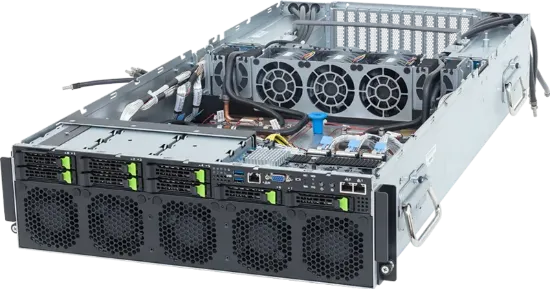
Immersion cooling represents the ultimate thermal Liquid-cooled GPU platform management solution for GPU servers, offering unparalleled heat removal capability, complete environmental isolation, and the highest compute density of any cooling technology. By submerging servers in dielectric fluid, immersion cooling eliminates 95-100% of air cooling requirements and enables GPU power densities exceeding 100kW per rack. This comprehensive guide examines immersion cooling technology for GPU servers, including implementation considerations, performance characteristics, and operational best practices for enterprise and government deployments.
Immersion Cooling Technology Overview
Immersion cooling operates on a simple principle: heat transfers more efficiently to liquid than to air due to the 1,000-3,000x higher thermal conductivity and specific heat capacity of dielectric fluids compared to air. By fully submerging GPU servers in dielectric fluid, every component surface becomes a heat transfer surface, eliminating the thermal bottlenecks of air cooling.
Single-Phase Immersion: Servers are submerged in dielectric fluid that remains in liquid state throughout the cooling cycle. Heat absorbed by the fluid is rejected through heat exchangers to facility water or external dry coolers. Fluid temperature: 35-55°C. Advantages: simpler system design, no phase change management, lower fluid cost, and well-understood maintenance procedures. Disadvantages: lower heat transfer coefficient than two-phase, larger fluid volume required.
Two-Phase Immersion: Dielectric fluid boils at server operating temperature (typically 45-65°C). Vapor rises, condenses on immersed condenser coils, and returns as liquid in a continuous cycle. Two-phase immersion achieves 5-10x higher heat transfer coefficients than single-phase, enabling the highest power densities. Advantages: passive heat transfer (no pumps required for fluid circulation within the tank), self-regulating (more heat = more boiling = more cooling), and minimal temperature variation across submerged components.
GPU Server Immersion: Performance and Benefits
Immersion cooling provides transformative benefits for GPU infrastructure:
Maximum GPU Performance: Immersion-cooled GPUs operate 15-30°C cooler than air-cooled equivalents under identical loads, enabling sustained maximum boost clock frequencies without thermal throttling. H100 GPUs in immersion maintain 1.95-2.0 GHz continuously versus 1.7-1.8 GHz with air cooling—a 10-15% sustained performance improvement. For 8-GPU servers running continuous training workloads, this translates to 1-2 additional training days per month.
Zero Fan Power: Immersion cooling eliminates all server fans, reducing server power consumption by 10-15%. For an 8-GPU H100 server (7kW typical), fan power reduction saves 700-1,050W per server. Over a 40-server cluster, annual savings exceed $40,000 at $0.12/kWh.
Complete Environmental Protection: Dielectric fluid completely isolates server components from humidity, dust, corrosive gases, and other environmental contaminants. Server failure rates from environmental causes drop to near zero. Circuit board corrosion, connector oxidation, and particulate contamination—leading causes of server failure in conventional data centers—are eliminated entirely.
Extraordinary Density: Immersion tanks support 40-80 GPU servers (320-640 GPUs) per rack-equivalent footprint, achieving AI compute densities of 250-500kW per rack. A single immersion tank can replace 10-20 air-cooled racks, dramatically reducing facility space requirements and associated costs.
Immersion Cooling for AI Training: Operational Considerations
Deploying GPU servers in immersion cooling requires modifications to standard operating procedures:
Server preparation: GPU servers must be prepared for immersion by removing or sealing components that cannot operate in dielectric fluid. This includes: removing standard power supplies (replaced with external power), sealing HDD/SSD bays (NVMe SSDs are immersion-compatible), removing or coating optical drives, and verifying that all connectors, cables, and components are fluid-compatible. NTS offers factory-prepared immersion-ready GPU server configurations with all necessary modifications.
Fluid management: Dielectric fluid requires regular quality monitoring and maintenance. Key parameters: dielectric strength (minimum 30kV per ASTM D877), viscosity, acidity (neutralization number), particulate count, and moisture content. Annual fluid sample analysis costs $500-$1,000 per tank. Fluid replacement interval: 5-10 years depending on fluid type and operating conditions.
Server servicing: Server maintenance requires removal from the immersion tank, draining, cleaning, and drying before opening. Specialized lifting equipment (5-10 ton capacity for populated tanks) and trained technicians are required. Mean time to repair (MTTR) increases from 1-2 hours (air cooled) to 4-8 hours for immersion systems.
Government and Defense Applications
Immersion cooling offers unique advantages for government AI deployments. The complete environmental isolation protects classified computing systems from TEMPEST surveillance (electromagnetic emissions). The sealed fluid environment complicates physical tampering and provides additional security for sensitive computing assets. NTS immersion systems for government applications include optional tamper detection, fluid level monitoring with security alerts, and secure access controls for tank enclosures.
Related Content
Explore more about this topic:
- Liquid Cooling vs Air Cooling for AI Racks
- Coolant Distribution Unit Selection
- Data Center Tier Classification for AI
Is immersion cooling safe for GPU servers?
Yes. Dielectric fluids used in immersion cooling are non-conductive and chemically inert with respect to server components. Google, Microsoft, and leading GPU deployment organizations have validated immersion cooling for production AI workloads. NTS has deployed immersion-cooled GPU servers in production environments since 2023 with zero fluid-related hardware failures.
What is the payback period for immersion cooling?
For clusters exceeding 32 GPUs, immersion cooling achieves payback in 12-24 months through power savings (eliminated server fans, reduced facility cooling), increased GPU performance (10-15% more throughput), and reduced floor space requirements. For larger clusters (256+ GPUs), payback accelerates to 6-12 months.
Can immersion cooling and air-cooled servers coexist in the same data center?
Yes. Immersion tanks are typically deployed in dedicated zones with raised floors or floor-standing configurations. The facility cooling system serves both immersion heat exchangers and air-cooled zones through separate loops. Most organizations adopt a phased approach, deploying immersion for high-density GPU racks while retaining air cooling for lower-density infrastructure.