
AI Inference vs Training Infrastructure: Understanding th…
Quick Summary
- Training: Requires high memory bandwidth, NVLink interconnects, batch throughput optimization
- Inference: Requires low latency, energy efficiency, model serving frameworks
- Cost Ratio: Training infrastructure costs 5-10x more than equivalent inference deployment
- GPU Choice: H100/A100 for training, L40S/L4 for inference, H200 for both
- Architecture: Training uses tensor parallelism; inference uses pipeline parallelism
Understanding the fundamental differences between AI inference and training infrastructure is critical for designing H100 AI training server cost-effective, high-performance machine learning systems. While both workloads leverage GPU acceleration, their hardware requirements, network topology, memory configurations, and operational characteristics diverge substantially. This guide provides an exhaustive technical analysis for enterprise architects and federal IT decision-makers evaluating infrastructure for production AI deployments.
Architectural Differences Between Training and Inference
AI training is a computationally intensive process where models learn patterns from vast datasets through iterative forward and backward propagation. Training demands high-precision floating-point computation (FP16, BF16, or FP8), massive memory bandwidth for gradient updates, and low-latency GPU-to-GPU communication for distributed synchronization across multiple nodes.
Inference, by contrast, applies trained models to new data, generating predictions or generated content. Inference prioritizes low latency (sub-millisecond to milliseconds), high throughput (thousands of requests per second), and memory capacity to hold model weights efficiently. While training requires 8-32 GPUs working in parallel, inference can often run on single GPUs or even CPU-based systems for smaller models.
GPU Requirements Comparison
| Characteristic | Training Infrastructure | Inference Infrastructure |
|---|---|---|
| GPU Memory Priority | Bandwidth (HBM3/HBM3e) | Capacity (HBM3 + system RAM) |
| Interconnect Required | NVLink 900 GB/s or InfiniBand | PCIe Gen5 or 100Gb Ethernet |
| Typical GPU Count | 8-4096 GPUs | 1-32 GPUs per service |
| Precision Requirements | FP16/BF16/FP8 for gradients | FP16/INT8/FP4 for weights |
| Memory per GPU | 80-192 GB minimum | 24-80 GB typical |
| Power per GPU | 700W+ (H100/H200) | 300-450W (L40S/L4) |
| Software Optimizations | Distributed training (FSDP, DeepSpeed) | Serving (TensorRT-LLM, vLLM) |
Training Infrastructure: Deep Dive
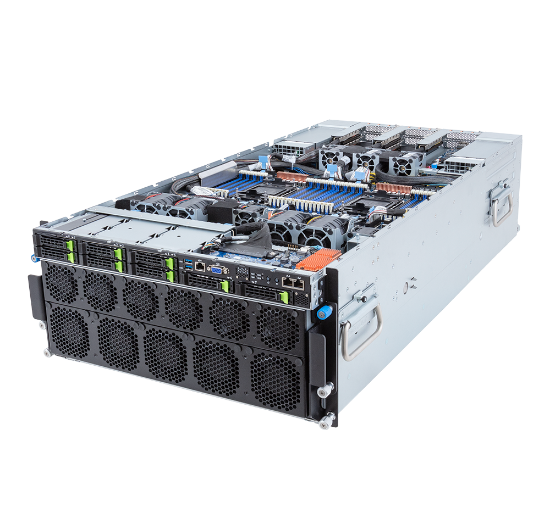
Production training clusters are among the most complex systems in modern computing. A typical enterprise-grade training node like the NTS Elite Apex 10U HGX B200 features 8x NVIDIA B200 GPUs with NVLink Switch interconnect, dual AMD EPYC or Intel Xeon processors, 2TB of system DDR5 memory, and 8x 400Gb ConnectX-8 NICs for inter-node communication. The total system power draw approaches 15kW per node, requiring dedicated liquid cooling infrastructure.
Key scaling challenges in training: Communication overhead grows with cluster size. While a single 8-GPU node achieves near-linear scaling, multi-node training introduces network latency. For Llama 3 405B training across 64 GPUs (8 nodes), communication can account for 15-30% of total training time depending on parallelism strategy (data, tensor, pipeline, or sequence parallelism).
Storage demands: Training requires high-throughput parallel file systems (Lustre, GPFS, or WEKA) capable of 100+ GB/s read throughput for data loading and frequent checkpoint writes. A typical Llama-scale training run produces 500GB-2TB of checkpoints every 1-2 hours, requiring both high bandwidth and low latency storage infrastructure.
Inference Infrastructure: Deep Dive
Production inference infrastructure prioritizes serving efficiency and cost-per-query over raw computational throughput. Inference servers like the NTS Elite Command 2U with 4x NVIDIA L40S GPUs deliver 200+ TFLOPS of FP16 inference while consuming under 3kW, making them ideal for high-density data center deployments.
Key inference optimization techniques: Weight quantization (FP16 -> INT8 -> FP4) reduces memory requirements and increases throughput by 2-8x with minimal accuracy loss. KV-cache optimization reduces memory pressure for long-context generation. Continuous batching (implemented in vLLM, TensorRT-LLM, and Triton Inference Server) maximizes GPU utilization by dynamically grouping requests.
Latency requirements: Real-time inference applications demand p95 latency under 100ms for conversational AI and under 500ms for document processing. Batch inference pipelines can tolerate 1-30 second latencies for high-throughput processing. These requirements directly impact GPU selection: L40S excels for real-time, H100 for batch throughput.
Converged Infrastructure: The Hybrid Approach
Many organizations deploy converged infrastructure that handles both training and inference. This approach leverages NVIDIA MIG (Multi-Instance GPU) or AMD MxGPU technologies to partition GPUs, allocating 4-7 GPU instances for training and 1-4 for inference. While this improves utilization, it introduces operational complexity in resource scheduling and can lead to suboptimal performance for both workloads.
Leading practice is to architect dedicated training clusters (using H100/H200/B200 with NVLink) and separate inference fleets (using L40S/L4/L20 or purpose-built inference accelerators), connected through a unified model registry and deployment pipeline. This separation optimizes both cost and performance for each workload type.
Federal and Government Considerations
U.S. government agencies must consider additional factors when designing training vs inference infrastructure. Training clusters handling classified or CUI (Controlled Unclassified Information) data require air-gapped network architectures, hardware security modules for key management, and NIST SP 800-53 security controls. These requirements add 20-40% to total infrastructure cost.
Inference deployments in federal settings must support model explainability (XAI) per Executive Order 14110, requiring inference servers that can log feature attributions and decision paths without introducing latency penalties. Hardware solutions include NVIDIA's accelerated XAI libraries and specialized inference nodes with integrated monitoring.
Related Content
Explore more about this topic:
- How Tensor Cores Accelerate Deep Learning
- What is NVLink? GPU Interconnect Guide
- NVIDIA H200 NVL Deep Dive
Can a single GPU server handle both training and inference?
Yes, but with significant trade-offs. Training throughput drops when sharing GPUs with inference, and inference latency increases when training is in progress. For production environments, dedicated infrastructure is strongly recommended.
What is the cost ratio between training and inference infrastructure?
Industry data shows inference infrastructure costs 3-5x less per GPU than training infrastructure when accounting for interconnect, storage, and cooling. However, inference infrastructure typically requires 5-10x more total GPUs in production deployments, making total inference costs 1.5-3x higher than training costs in mature AI organizations.
How does model size affect inference hardware selection?
Models under 7B parameters can run efficiently on L40S (48GB) or A10 (24GB) GPUs. Models in the 7B-70B range require H100 (80GB) or MI300X (192GB) for acceptable batch sizes. Models above 70B parameters require multi-GPU inference with tensor parallelism, similar to training infrastructure.
What inference optimization provides the best ROI?
Weight quantization (INT8/FP4) combined with continuous batching delivers the highest ROI, reducing per-query costs by 4-8x in most production deployments. Model distillation and pruning require more engineering effort but can provide additional 2-3x improvements.