
Liquid Cooling vs Air Cooling for AI Racks: Complete Comp…
Quick Summary
- Air Cooling: Effective up to 500-600W per GPU, 15-25kW per rack, lower upfront cost
- Liquid Cooling: Handles 700-2000W+ GPUs, 35-100kW+ per rack, 30% lower energy costs
- PUE: Air achieves 1.5-1.8; liquid achieves 1.05-1.15
- Best for Air: Deployments with <500W GPUs or existing data center infrastructure
- Best for Liquid: High-density clusters, >700W GPUs, new facilities
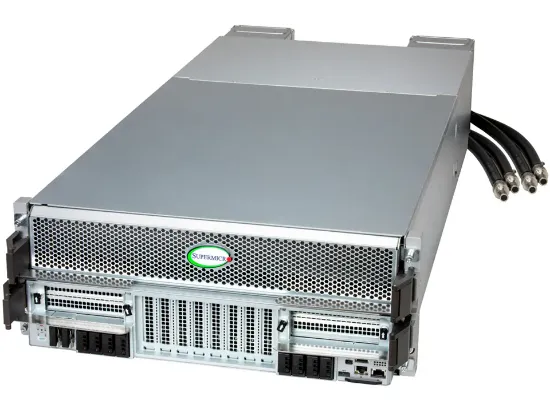
The choice between liquid cooling and air cooling for AI infrastructure Liquid-cooled AI server is one of the most consequential decisions in data center design for GPU-accelerated computing. As GPU power densities have escalated from 250W (A100) to 700W (H100/H200) and beyond 1000W (B200), traditional air cooling approaches are reaching their practical limits. This comprehensive comparison examines every dimension of cooling technology for AI racks, providing data-driven guidance for infrastructure decision-makers.
Thermal Challenges in Modern GPU Infrastructure
Modern GPU servers present unprecedented thermal management challenges. An 8-GPU HGX H100 server generates 7-10.2kW of heat in a compact 8U form factor—a heat density of 875-1275W per rack unit, compared to 100-200W per U for traditional enterprise servers. At rack scale (4-5 GPU servers per rack), total heat output reaches 35-50kW per rack, exceeding the cooling capacity of most air-cooled data centers.
Thermal design power (TDP) trends compound this challenge. NVIDIA H100 SXM: 700W. AMD MI300X: 750W. NVIDIA B200 SXM: 1000W+. Future GPUs are projected to reach 1500-2000W by 2028-2030. Air cooling, which effectively handles up to approximately 500-600W per component, is being pushed beyond its economic and physical limits for high-density GPU deployments.
Air Cooling for GPU Servers: Capabilities and Limits
Air cooling remains the dominant approach for GPU infrastructure, with well-understood design principles and lower upfront costs. Modern air-cooled GPU servers use high-performance heat sinks with vapor chamber technology, high-static-pressure fans (40-80mm), and optimized airflow channels to maximize heat transfer.
Air cooling capabilities (GPU TDP): Standard 1U servers: up to 300W per GPU. Standard 2U servers: up to 400W per GPU. Custom 4U+ servers with oversized heat sinks: up to 600W per GPU. Air cooling cannot reliably handle GPUs above 600-700W TDP without significant noise (85+ dBA), airflow (100+ CFM per GPU), and temperature margin compromises.
Data center implications: Air-cooled GPU racks are limited to 15-25kW per rack for reliable operation. Higher densities require reducing ambient temperatures (18°C instead of 24°C), increasing airflow (500+ CFM per kW), and accepting higher fan power consumption (15-25% of total IT load for cooling fans).
Best air-cooled GPU configurations: 4x H100 (700W) in a 4U chassis with optimized airflow—achievable with 50-60 dBA fan noise and 28°C inlet temperature. This configuration is suitable for most enterprise data centers with existing air cooling infrastructure.
Liquid Cooling for GPU Servers: Technologies and Benefits
Liquid cooling removes 70-95% of GPU heat directly at the source using circulating coolant, bypassing the air cooling chain entirely. Three primary liquid cooling technologies address GPU thermal management:
Direct-to-Chip (DTC) Cooling: Cold plates mounted directly on GPU packages circulate coolant (typically 25-45°C water or dielectric fluid) through microchannel fins that extract heat at the die surface. DTC removes 80-90% of GPU heat directly, with remaining heat handled by server fans for VRMs, memory, and other components. DTC enables GPU TDPs up to 2000W+ and reduces facility cooling energy by 40-50%.
Immersion Cooling: Servers are fully submerged in dielectric fluid that absorbs heat through direct contact with all components. Single-phase immersion (fluid remains liquid) and two-phase immersion (fluid boils and condenses) provide 95%+ heat capture. Immersion eliminates server fans entirely, reducing server power consumption by 10-15% and enabling the highest rack densities (100kW+ per rack).
Rear Door Heat Exchangers (RDHx): A hybrid approach where server heat is rejected to facility water through cooling coils mounted on the server or rack exhaust. RDHx captures 60-80% of heat load at the rack level, reducing data center cooling load without requiring server modifications. RDHx supports rack densities of 30-50kW.
Cost Analysis: 3-Year TCO Comparison
| Cost Category | Air Cooling (20kW/rack) | DTC Liquid (50kW/rack) | Immersion (100kW/rack) |
|---|---|---|---|
| Cooling Infrastructure Cost | $25,000-$35,000/rack | $45,000-$65,000/rack | $60,000-$85,000/rack |
| Server Cooling Premium | $0 (standard) | $2,000-$5,000/server | $1,500-$3,000/server |
| Annual Power Cost (cooling) | $12,000-$18,000 | $4,000-$7,000 | $2,000-$4,000 |
| Maintenance (annual) | $2,000-$4,000 | $4,000-$8,000 | $3,000-$6,000 |
| Space Efficiency (GPUs/sq ft) | 8-12 GPUs/sq ft | 20-40 GPUs/sq ft | 40-80 GPUs/sq ft |
| 3-Year TCO per GPU | $8,000-$12,000 | $6,000-$9,000 | $5,000-$7,500 |
Federal and Government Deployment Considerations
U.S. government AI data centers must consider additional factors when selecting cooling technology. Liquid cooling introduces potential single points of failure (coolant leaks, pump failures) that conflict with Tier III/Tier IV availability requirements. Redundant cooling loops with N+1 pump configurations and automatic leak detection are mandatory for government deployments.
Security considerations: Liquid cooling systems provide potential physical access paths to servers that must be secured per ICD 705 (Technical Security Standards for SCIFs). Coolant lines entering and exiting secure areas require tamper detection and physical security controls. NTS offers liquid cooling configurations with integrated leak detection, automatic shutoff valves, and security monitoring interfaces.
Related Content
Explore more about this topic:
- Data Center Tier Classification for AI
- GPU Thermal Throttling: Prevention Strategies
- AI Infrastructure TCO: Budgeting Guide
Can I retrofit my existing data center for liquid-cooled GPU servers?
Retrofit is possible but requires facility plumbing modifications, CDU (Coolant Distribution Unit) installation, and rack-level coolant distribution hardware. Typical retrofit cost: $15,000-$30,000 per rack. New construction with liquid cooling: $8,000-$15,000 per rack.
What happens if liquid cooling fails?
Liquid-cooled GPU servers retain fans for emergency cooling. In the event of coolant loop failure, servers automatically throttle GPU performance to reduce heat output and can operate indefinitely at reduced capacity (50-60% of maximum performance) on air cooling alone.
Is liquid cooling worth it for small GPU deployments?
For clusters under 8 GPUs (single server), air cooling is sufficient and cost-effective. Liquid cooling ROI becomes positive at 16+ GPUs (2+ servers) and strongly positive at 32+ GPUs (4+ servers) in a single rack.