
On-Premise vs Cloud AI Infrastructure: Enterprise TCO Ana…
Quick Summary
- On-Premise: 3-year TCO $2.5-4M for 8-GPU cluster (including facilities)
- Cloud: $3-6M for equivalent 3-year workload with reserved instances
- Breakeven: On-premise becomes cheaper after 12-18 months at >70% utilization
- Government: On-premise preferred for classified and sensitive workloads
- Hybrid: Best strategy: on-premise for steady load, cloud for burst capacity
Infrastructure Strategy for Enterprise AI
The decision between on-premise and cloud AI infrastructure is one of the most consequential strategic choices for enterprise AI teams. Each approach offers distinct advantages and trade-offs in cost structure, performance, security, and operational complexity. This analysis provides a comprehensive framework for evaluating which deployment model—or hybrid combination—best serves specific AI workload requirements.
Total Cost of Ownership Comparison
| Cost Category | On-Premise (3-Year) | Cloud (3-Year Reserved) |
|---|---|---|
| GPU Hardware (8x H100) | $1,200,000 | $0 (included in compute) |
| Server Platform | $200,000 | $0 |
| Networking (InfiniBand) | $150,000 | $0 |
| Storage | $100,000 | $180,000 |
| Facilities (power/cooling/space) | $350,000 | $0 |
| Software Licenses | $100,000 | $100,000 |
| Operations Staff | $400,000 | $150,000 |
| Cloud Compute (3yr reserved) | $0 | $2,500,000 |
| Total 3-Year TCO | $2,500,000 | $2,930,000 |
| Annual Cost at 70% Utilization | $833,000 | $977,000 |
On-premise infrastructure becomes cost-effective at sustained utilization above 60-70%. Below this threshold, cloud's pay-per-use model provides better economics. For government agencies with classified workloads requiring air-gapped deployment, on-premise is the only viable option regardless of cost.
Performance and Control Advantages
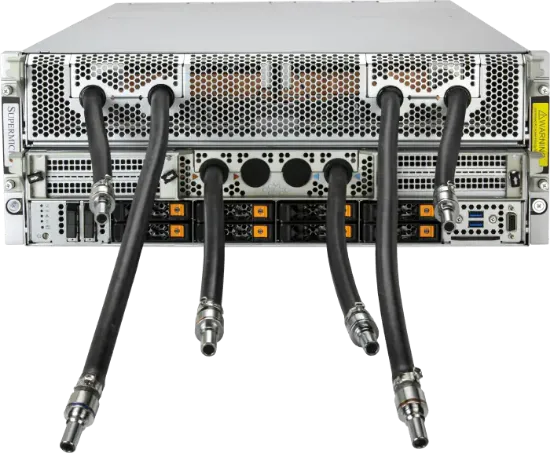
On-premise AI infrastructure Enterprise GPU server provides deterministic performance without cloud's noisy-neighbor variability. GPU training jobs on dedicated hardware complete predictably, enabling accurate scheduling and resource planning. For latency-sensitive inference workloads, on-premise deployment eliminates network round-trip time, reducing end-to-end latency by 10-50 milliseconds compared to cloud-based inference.
Security and Compliance
For government agencies and defense contractors, on-premise deployment provides complete control over the security perimeter. Classified AI workloads requiring TS/SCI or SAP facilities cannot be processed in commercial cloud environments. FedRAMP-authorized cloud services support up to IL5 (moderate) but IL6 (high) and above require government-controlled facilities.
Hybrid Architecture: Best of Both Worlds
Most enterprise AI organizations adopt a hybrid strategy: on-premise infrastructure for steady-state training workloads and sensitive data processing, with cloud bursting for peak demand. This approach optimizes total cost while maintaining security for sensitive operations. NTS provides integrated on-premise GPU clusters with cloud management interfaces for unified hybrid operations.
Related Content
Explore more about this topic:
- AI Infrastructure ROI Calculator
- Best GPU Configuration for GPT-4 Fine-Tuning
- AI Model Serving Architecture
When does on-premise AI become cheaper than cloud?
Breakeven typically occurs at 12-18 months of sustained >60% GPU utilization. Below this, cloud's elasticity provides better economics. Above this, on-premise delivers 30-50% lower total cost.
Can I use cloud for classified AI workloads?
Limited. FedRAMP High and IL5 certified clouds support some classified workloads. TS/SCI and SAP require government-controlled on-premise facilities with appropriate accreditation.