
Deploying Open-Source LLMs On-Premise: Infrastructure Guide
Quick Summary
- Llama 3 70B: Requires 140GB VRAM, fits on 2x H100
- Mistral Large: Requires 120GB VRAM, efficient MOE architecture
- Falcon 180B: Requires 360GB VRAM, needs 4-8x H100 cluster
- vLLM: Recommended serving framework for open-source LLMs
- Security: On-premise deployment ensures data sovereignty
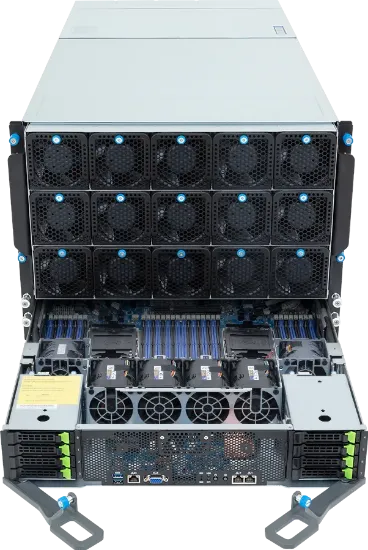
Deploying Open-Source LLMs On Enterprise GPU server-Premise
Open-source large language models—including Meta Llama 3, Mistral AI, Falcon, Qwen, and DeepSeek—offer enterprise and government organizations the benefits of AI without proprietary licensing restrictions, data privacy concerns, or dependency on external API providers. This guide covers the infrastructure requirements and deployment architectures for running open-source LLMs on on-premise GPU infrastructure.
Model Selection and Requirements
| Model | Parameters | Memory (FP16) | Min GPUs | Recommended Config |
|---|---|---|---|---|
| Llama 3 8B | 8B | 16 GB | 1 | 1x L40S or L4 |
| Llama 3 70B | 70B | 140 GB | 2 | 2x H100 or 1x MI300X |
| Llama 3 405B | 405B | 810 GB | 5 | 5x H200 NVL or 8x H100 |
| Mistral Large | 123B | 246 GB | 3 | 3x H100 or 3x MI300X |
| Falcon 180B | 180B | 360 GB | 5 | 5x H100 with NVLink |
| Qwen 72B | 72B | 144 GB | 2 | 2x H100 or 1x MI300X |
Serving Framework Options
vLLM is the most popular open-source serving framework for open-source LLMs, offering PagedAttention for efficient KV cache management, continuous batching for high throughput, and tensor parallelism for multi-GPU deployment. TensorRT-LLM provides NVIDIA-optimized serving with the highest possible performance but requires model conversion. For production enterprise deployments, Triton Inference Server with TensorRT-LLM or vLLM backends provides monitoring, logging, and scaling capabilities.
Security Considerations
On-premise deployment of open-source LLMs addresses security concerns that cloud APIs cannot. Training data, model weights, and inference inputs remain within organizational control. For defense and intelligence applications, models can be deployed on air-gapped networks without any external connectivity. NTS provides hardened open-source LLM deployment configurations with encrypted storage, access control, and audit logging.
Related Content
Explore more about this topic:
- NVIDIA B200 vs H100: Architecture Comparison
- NVIDIA H200 NVL Deep Dive
- How Tensor Cores Accelerate Deep Learning
Can I run multiple open-source models on shared GPU infrastructure?
Yes. NVIDIA MIG partitions individual GPUs for smaller models. For larger models, Kubernetes with GPU node selectors and affinity rules enables efficient multi-model serving on shared GPU clusters.
Do open-source LLMs require fine-tuning for government use?
Pre-trained open-source LLMs handle general tasks effectively. Government-specific terminology, document formats, and regulatory knowledge typically benefit from fine-tuning on 1,000-10,000 domain-specific examples.