
Rack Design for AI Clusters: Best Practices
Quick Summary
- Power Density: AI racks draw 35-50kW vs 5-10kW for traditional racks
- Cooling: Liquid cooling recommended for >15kW per rack
- Weight: GPU servers weigh 180-250 lbs each; racks require 2,500+ lb rating
- Networking: Three independent networks required: compute, storage, management
- Cable Management: Structured cabling with bend radius control for AOC cables essential
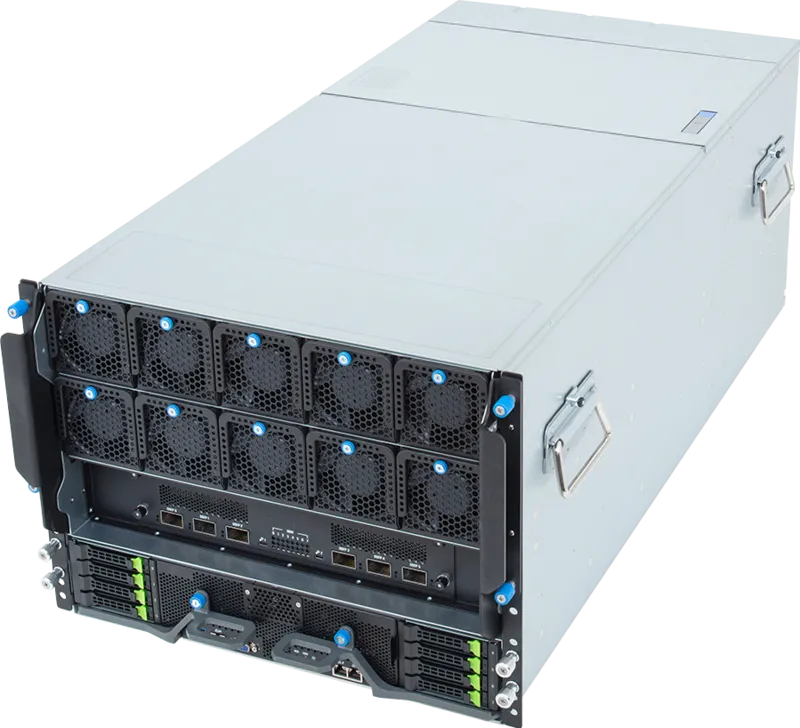
Rack design for AI clusters Liquid-cooled rack server requires a fundamentally different approach than traditional enterprise data center planning. AI training clusters—particularly those housing 8-GPU NVIDIA HGX or AMD MI300X servers—generate unprecedented heat density, consume extraordinary power, and demand specialized networking and cooling infrastructure. This guide provides comprehensive best practices for designing AI cluster rack layouts optimized for performance, reliability, and serviceability.
Understanding AI Cluster Power Density
Modern GPU servers consume 3-15kW per rack unit, compared to traditional enterprise servers at 0.5-1kW per unit. A single fully-populated rack of 8x HGX H100 servers (4 nodes per rack at 10kW each) draws 40kW—equivalent to 80 traditional 1U servers. This power density fundamentally alters every aspect of rack design from electrical distribution to thermal management.
Power planning targets: Each HGX H100 server draws 7-10.2kW under full training load. For a 40-rack cluster containing 160 servers (1,280 GPUs), total power requirements reach 1.4-1.6MW for computing alone, plus 0.5-0.8MW for cooling, networking, and overhead—a total facility load of 2-2.4MW.
Rack Layout and Configuration
AI cluster racks require 48U-52U enclosures with enhanced weight capacity (2,500-3,000 lbs rating) due to GPU server weight. Each 8U HGX server weighs 180-250 lbs fully configured, and a populated rack with 4-5 servers plus networking and PDUs approaches 1,500 lbs.
Recommended rack layout for 8-GPU servers: Position the heaviest servers at the bottom 8-16U for stability. Place InfiniBand or Ethernet switches at the top of rack (ToR) position in U1-4. Allocate U5-6 for patch panels and cable management. Distribute servers in U7-14, U15-22, U23-30, and U31-38 based on cable reach limits.
Aisle containment: Hot aisle/cold aisle containment is mandatory for AI clusters. GPU server exhaust temperatures reach 45-55°C (113-131°F), and without containment, recirculation causes hotspots that reduce GPU performance through thermal throttling. Cold aisle containment with 18-22°C supply air is recommended.
Power Distribution Design
AI clusters require 3-phase power distribution at 208V or 415V. For US government facilities, 208V 3-phase is standard, delivering 6-8kW per circuit. Each HGX H100 server requires 2-3 30A 208V circuits (L6-30P or CS8365C connectors).
PDU selection: Switched 3-phase PDUs with per-outlet monitoring are essential. Each rack requires dual feed (A and B power feeds) for redundancy. For 40kW racks, dual 60A 3-phase feeds provide adequate capacity with 25% headroom for startup surges.
Generator and UPS planning: AI clusters should not be on standard UPS systems. A 2MW facility requires a 2.5-3MVA UPS with 5-10 minutes runtime for graceful shutdown, backed by a 3MW diesel or natural gas generator. Battery energy storage systems (BESS) are increasingly preferred for their faster response and lower maintenance.
Networking and Cable Management
AI training clusters require three independent networks: computing (InfiniBand or high-speed Ethernet for GPU communication), storage (100/200/400GbE for data access), and management (1/10GbE for BMC/IPMI). Each network requires separate cabling infrastructure.
InfiniBand fabric: For clusters of 32-1024 GPUs, InfiniBand NDR400 (400 Gbps) is the recommended compute fabric. Each HGX node requires 4-8x NDR400 links for full bisection bandwidth. Cable management for 64 ports per rack requires 1-2U overhead cable trays with bend radius control for active optical cables (AOCs).
Storage network: Parallel file systems require dedicated 100/200GbE storage networks. Each node connects to the storage fabric via 2-4x 100GbE links. Storage switches (e.g., NVIDIA Spectrum-4 or Arista 7800 series) are typically deployed in dedicated rows separate from compute racks.
Cooling Infrastructure Integration
AI clusters exceeding 20kW per rack require liquid cooling. Direct-to-chip (DTC) cooling using cold plates attached to GPU and CPU packages removes 70-80% of heat load at the source, reducing facility cooling requirements by 40-50% compared to air cooling alone.
CDU (Coolant Distribution Unit) placement: For liquid-cooled racks, position one CDU per 2-4 racks. CDUs manage coolant temperature (35-45°C supply), flow rate (10-30 L/min per server), and pressure differential. Each CDU requires facility water connections and 5-10kW of auxiliary power for pumps and controls.
Air-cooled fallback: Even with liquid cooling, GPU servers retain fans for redundancy and servicing. Rack-level airflow management must handle 30-50% of total heat load through air, requiring 1,500-2,500 CFM per rack.
Government Facility Standards
U.S. federal AI clusters must comply with additional standards including UFC 3-501-01 (electrical engineering), UFC 3-410-01 (heating and cooling), and NIST SP 800-53 (security controls for physical access). Government data centers typically require Tier III or Tier IV redundancy, meaning the rack design must support concurrent maintenance without downtime—a significant challenge for liquid-cooled AI clusters that require specialized training for maintenance personnel.
Related Content
Explore more about this topic:
- How Tensor Cores Accelerate Deep Learning
- What is NVLink? GPU Interconnect Guide
- NVIDIA B200 vs H100: Architecture Comparison
How many H100 servers fit in a standard 48U rack?
With proper power and cooling, a standard 48U rack accommodates 4-5 HGX 8U servers, leaving space for ToR switches (1U), patch panels (1-2U), and PDUs (2-3U per side). Higher-density liquid-cooled racks can support 6 servers with reduced service clearances.
What is the optimal rack row layout for AI clusters?
Row lengths of 8-12 racks optimize cable reach for InfiniBand fabrics. Shorter rows waste valuable floor space; longer rows require signal repeaters. Standard row width of 8ft (2.4m) with 4ft (1.2m) cold aisles provides adequate clearance for GPU server installation.
Can existing data centers be retrofitted for AI clusters?
Retrofit is possible but typically limited to 20-30kW per rack without major electrical and cooling upgrades. Full AI cluster capability (40kW+/rack) generally requires new facility construction or significant modernization including 3-phase power distribution, liquid cooling loops, and enhanced fire suppression systems.
What fire suppression is appropriate for AI clusters?
Standard VESDA (Very Early Smoke Detection Apparatus) with double-interlock pre-action sprinklers is recommended. Liquid-cooled clusters require leak detection at every connection point, with automatic valve shutoff and gravity drain systems to protect equipment from coolant leaks.