
Renewable Energy Integration for AI Data Centers: Sustain…
Quick Summary
- Solar: On-site + PPAs can offset 30-60% of AI data center power
- Wind: Best for night-time computing, complements solar
- Battery Storage: 2-4 hour BESS smooths renewable intermittency
- Nuclear: SMRs emerging as 24/7 carbon-free option for mega-clusters
- Federal: Executive Order 14057 requires 100% carbon-free by 2030
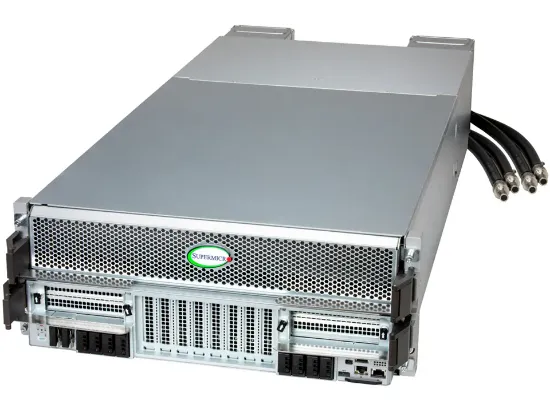
Renewable Energy for AI Data Centers Dual EPYC GPU server
AI data centers consume extraordinary amounts of electricity—a 1,024 GPU H100 cluster draws 7-10MW continuously, consuming 60,000-90,000 MWh annually. This energy consumption has significant financial and environmental implications. Integrating renewable energy sources reduces both operational costs and carbon footprint while supporting federal sustainability mandates.
Federal Renewable Energy Requirements
Executive Order 14057 requires federal agencies to achieve 100% carbon-free electricity by 2030 and net-zero emissions by 2050. Agency AI data centers must develop renewable energy procurement strategies to meet these mandates. Available mechanisms include on-site generation (solar, wind), power purchase agreements (PPAs), renewable energy certificates (RECs), and virtual PPAs (VPPAs) for facilities without on-site renewable potential.
Solar Integration for AI Facilities
Large-scale AI data centers in sun-rich regions (Southwest US, California, Texas) can offset 20-40% of annual energy consumption through on-site solar photovoltaic systems. A 10MW AI facility requires approximately 40-50 acres of solar panels for 30% annual offset. Paired with 20-40MWh battery storage, solar can reduce grid energy purchases during peak sunlight hours.
Nuclear Options for AI Mega-Clusters
Small Modular Reactors (SMRs) are emerging as a promising carbon-free power source for large AI data centers. SMRs provide 50-300MW of 24/7 baseload power without intermittency challenges of solar and wind. Several AI operators have announced colocation agreements with SMR developers for 2028-2030 deployment. For government AI facilities requiring guaranteed power, SMRs offer energy independence and supply security.
Related Content
Explore more about this topic:
- GPU Thermal Throttling: Prevention Strategies
- Coolant Distribution Unit Selection
- Data Center Tier Classification for AI
Can existing data centers add renewable energy?
Yes. Options include on-site solar (if land is available), VPPAs for off-site renewable procurement, and REC purchases for carbon accounting. NTS provides renewable energy feasibility assessments for AI data center facilities.
How does renewable energy affect AI operating costs?
Solar PPAs typically provide electricity at $0.02-0.04/kWh versus $0.06-0.12/kWh grid rates. Combined with federal tax incentives (ITC, PTC), renewable-powered AI facilities can achieve 30-50% lower energy costs over 20-year project terms.