
Intel Xeon 6 vs AMD EPYC 9005: Best CPU Platform for AI S…
Quick Summary
- Xeon 6: Up to 128 P-cores, AMX for AI, PCIe Gen5, CXL 2.0
- EPYC 9005: Up to 192 cores, 12-channel DDR5, 128 PCIe Gen5 lanes
- Core Count: EPYC offers 50% more cores than Xeon at similar TDP
- AI Acceleration: Intel AMX provides matrix multiply built into CPU
- Selection: EPYC for core-density workloads, Xeon for balanced AI
CPU Platform Comparison for AI Servers
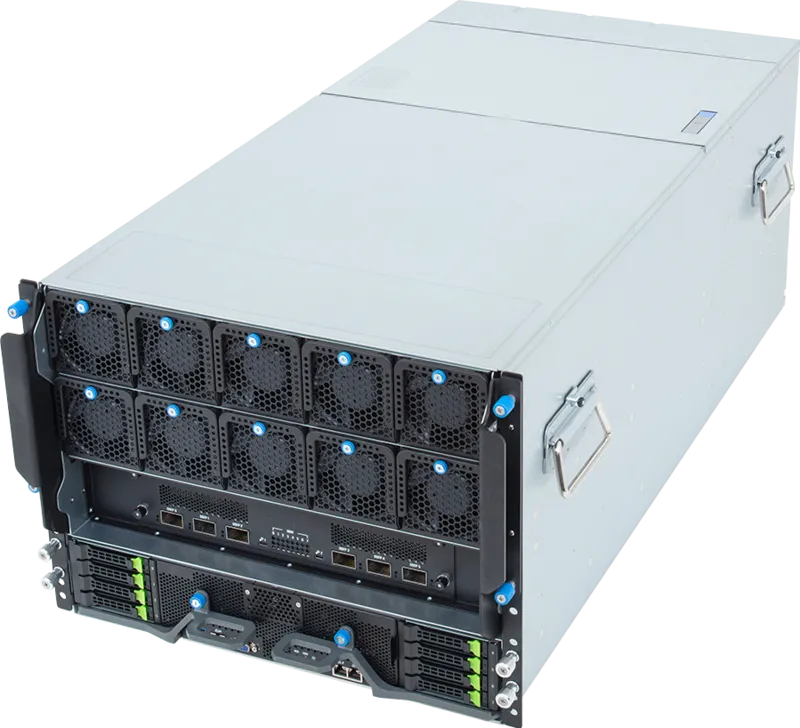
While GPUs perform the heavy computation in AI workloads, the CPU platform plays a critical role in data preprocessing, model loading, orchestration, and system management. The choice between Intel Xeon 6 and AMD EPYC Dual Xeon GPU server 9005 series processors affects PCIe lane count, memory bandwidth, platform cost, and overall system reliability for GPU server deployments. This comparison provides detailed analysis for enterprise and government server procurement decisions.
| Feature | Intel Xeon 6 (Granite Rapids) | AMD EPYC 9005 Dual EPYC GPU server (Turin) |
|---|---|---|
| Max Cores | 128 P-cores | 192 Zen 5 cores |
| Memory Channels | 8-channel DDR5 | 12-channel DDR5 |
| Max Memory | 4 TB | 6 TB |
| PCIe Lanes | 80 lanes Gen5 | 128 lanes Gen5 |
| AI Acceleration | Intel AMX | AVX-512 (Zen 5) |
| CXL Support | CXL 2.0 | CXL 2.0 |
| TDP Range | 350-500W | 400-600W |
PCIe Lane Count: Critical for GPU Density
For GPU servers, PCIe lane count is the most important CPU specification. Each dual-slot GPU requires 16 PCIe Gen5 lanes. An 8-GPU server requires 128 PCIe lanes for GPUs alone, plus additional lanes for NVMe storage (4-8 lanes), networking (16-32 lanes), and platform devices. AMD EPYC's 128 PCIe lanes per socket (256 in dual-socket) provide superior GPU connectivity without lane sharing. Intel Xeon 6's 80 lanes per socket require PCIe switches for dense GPU configurations, adding cost and latency.
Memory Bandwidth for AI Preprocessing
AI training pipelines require high CPU memory bandwidth for data loading and preprocessing. EPYC's 12-channel DDR5 provides 50% more memory bandwidth than Xeon's 8-channel configuration, enabling faster dataset loading and reduced GPU idle time. For workloads with complex online data augmentation, this bandwidth advantage translates to 5-15% higher overall training throughput.
AI Acceleration Features
Intel Xeon 6 includes Advanced Matrix Extensions (AMX), which provide hardware matrix multiplication within the CPU. While not competitive with GPU performance, AMX enables efficient CPU-based inference for latency-sensitive applications where GPU overhead is undesirable. AMD EPYC 9005 relies on AVX-512 instructions for AI acceleration, which provides wider SIMD operations but lacks dedicated matrix hardware.
Related Content
Explore more about this topic:
Frequently Asked QuestionsWhich CPU platform is better for GPU servers?
AMD EPYC generally provides better value for GPU-dense servers due to higher PCIe lane counts and memory bandwidth. Intel Xeon 6 excels in environments requiring CPU-based AI inference or integrating with Intel-specific technologies.
Are both platforms available through federal contracts?
Yes, both Intel and AMD platforms are available through NTS with GSA Schedule and SEWP V pricing. Federal agencies can specify either platform based on performance requirements and existing infrastructure.